NUK Perfect Match Medium Flow Baby Bottle 8oz/3pk: A Parent's Practical Verdict
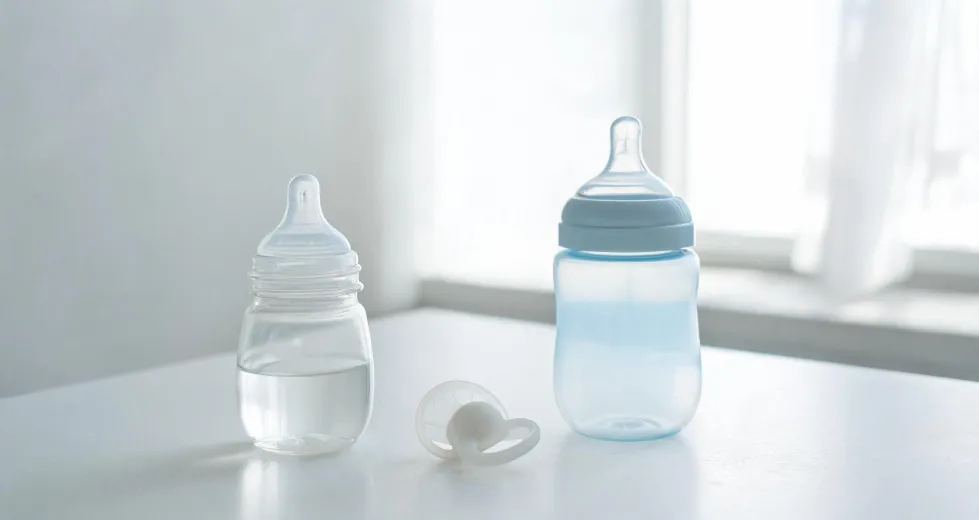
The 9 p.m. scene: a kitchen counter covered in the artifacts of a working parent's evening—drying pump parts, a half-finished bottle, and a new three-pack of NUK Perfect Match 8-ounce bottles with medium-flow nipples still in packaging. Daycare starts at 6:30 a.m., so everything has to be clean, filled, and ready by bedtime. You've just moved your four-month-old from slow-flow bottles, and you're holding a nipple, trying to remember what 'medium' actually means for a baby who still sputters when milk comes too fast. NUK's own site makes a big promise: the line adapts to a baby's natural way of feeding and soothing, mapping development from 0-6 months through 6-18 months and beyond. That sounds like the product was designed around your baby's stage, not the other way around. But brand pages sell a philosophy—they don't tell you whether this nipple will match your baby's swallowing rhythm. The practical answer is conditional: the 8oz/3pk earns its place only when the flow matches your baby's real feeding cues and your nightly sanitizing routine can keep up.
The 9 p.m. Bottle Station
It's 9 p.m. and the kitchen counter is covered in the artifacts of a working parent's evening: a drying rack full of pump parts, a half-finished bottle from the last feed, and a three-pack of NUK Perfect Match 8-ounce bottles with medium-flow nipples still in their packaging. Daycare starts at 6:30 a.m., so everything has to be clean, filled, and ready by the time you fall into bed. You've just moved your four-month-old from slow-flow bottles, and you're holding a nipple, trying to remember what 'medium' actually means for a baby who still sputters when milk comes too fast. NUK's own site makes a big promise about this line: it adapts to a baby's natural way of feeding and soothing, mapping development from 0-6 months through 6-18 months and beyond, with every milestone framed as a reason for celebration. That sounds like the product was designed around your baby's stage, not the other way around. Brand pages, though, sell a philosophy; they don't tell you whether this nipple will match your baby's swallowing rhythm. The practical answer is conditional: the 8oz/3pk earns its place only when the flow matches your baby's real feeding cues and your nightly sanitizing routine can keep up.
The real question isn't whether NUK Perfect Match is a good bottle—it's whether this specific 8oz/3pk, medium-flow version is the right tool for this specific transition. Most parents usually make this decision in one of two ways: they buy the next size up because their baby 'seems ready,' or they keep using slow-flow because it works and they're afraid to change. Neither approach actually looks at the baby. The honest version of the question has three parts. First, does the medium-flow rate match how your baby actually feeds—or will it turn a calm feed into a coughing fit? Second, does the 8-ounce capacity make sense for your baby's current intake, which at four to six months usually sits between four and eight ounces per feed? And third, can you keep up with the cleaning and sanitizing routine that a three-bottle rotation demands, especially when your baby is still under six months and the immune system is still building? Most buyers skip that third question entirely.
When 'Perfect Match' Isn't Just a Label
The name 'Perfect Match' could easily be written off as marketing, so look at what NUK actually puts behind it. On its product pages, NUK describes the Perfect Match line in terms of feeding and soothing that follow a baby's natural development, with content organized by stage, from pregnancy through 18+ months. The brand's own language ties the bottle to milestones rather than to a fixed nipple size—the point is that the product should change as the baby changes, not that one bottle works for every age. That distinction matters because it reframes how you should read 'medium flow.' It's not a universal next step after slow flow; it's a stage-specific setting meant to match a baby who is starting to drink more actively. If the bottle is designed around the idea of adapting to natural feeding, then the medium-flow nipple is only 'correct' when the baby's feeding behavior has actually developed to the point where a faster flow is comfortable. This single insight changes the decision from 'which bottle should I buy' to 'where is my baby in this stage map'—and if the baby isn't there yet, the label alone doesn't make the bottle right.
The stage link becomes concrete when you look at NUK's own description of what happens at six months: NUK's milestone content describes the period from six months onward as a whirlwind—first teeth, determined crawls, wobbly steps—when a baby becomes a 'vibrant explorer.' That's the same window where feeding changes: babies start taking more milk per feed, feeding sessions become more efficient, and a slow-flow nipple can feel frustratingly slow. This is the argument for moving to medium flow. But notice the condition embedded in NUK's own framing: the bottle exists to support what the baby is actually doing, not to push the baby into what the packaging suggests. If your baby is four months old and still pauses between swallows, the brand's milestone map actually puts you in the 0-6 months stage, where slow flow may still be the honest match. The 'medium' label only earns its name when the baby's feeding behavior has caught up to the stage it's designed for. That's the part that gets lost when parents read 'medium flow' as 'faster, therefore better.'
Eight Ounces, Three Bottles, Many Trade-offs
So what does the 8oz/3pk medium-flow bottle actually compete against? Three realistic alternatives: the same bottle in 5-ounce size with slow-flow nipples, the 8-ounce with slow-flow, and a single 8-ounce medium-flow bottle rather than a pack. The 5-ounce slow-flow wins on low risk—it matches a younger baby's intake and swallowing pace, but you'll buy a new set within a couple of months. The 8-ounce slow-flow keeps the capacity you'll eventually need while keeping the gentle flow, but a four-month-old who is used to slow flow will probably take longer to finish a feed. The single 8-ounce medium-flow bottle is the cheapest way to test the flow, but it leaves you washing and sanitizing one bottle constantly, which is exactly the chore that makes a three-pack attractive in the first place. The 8oz/3pk medium-flow pack lands in the middle: it gives you a day's rotation for daycare, enough capacity for the larger feeds that start around six months, and a flow rate that matches an older infant—assuming your baby is actually at that stage. The trade-off is that you've committed to three bottles of a flow you can't test without opening them all.
Before you commit to that trade-off, run a quick self-check based on what's happening at your own kitchen counter. Does your baby finish slow-flow feeds without frustration, or do they push the bottle away, arch their back, and fuss for more? That fuss is the signal that a faster flow might genuinely help. Does your baby cough or sputter when you switch to a faster nipple, or do they gulp steadily? If the cough appears, you've just learned that 'medium' is ahead of your baby's current ability, regardless of age. How much does your baby actually drink in a feed, and does an 8-ounce bottle leave you throwing away a lot of milk? If your baby routinely stops at 4 or 5 ounces, the bigger bottle doesn't hurt, but it doesn't help either—the flow, not the capacity, is the deciding factor. And, finally, who washes the bottles? If you're the one doing the 9 p.m. sanitizing run, then the three-pack only solves a convenience problem you actually have; if you're already drowning in pump parts, a third bottle to clean can feel like a fourth job.
The Sanitizing Rule That Changes Your Math
The comparison above treats the decision as a flow-and-capacity problem. The CDC's guidance on infant feeding items re-frames it as a hygiene-system problem, and that reframing changes the math. In guidance updated in March 2025, the CDC says to clean infant feeding items daily and to sanitize them either for extra germ removal or daily if a baby is under 2 months old, was born prematurely, or has a weakened immune system. For a baby under six months, that everyday-sanitizing recommendation effectively applies, and the CDC states it as a key point. What this changes is the value of the 3-pack. A single 8-ounce medium-flow bottle you sanitize once a day is a small chore. Three bottles—plus pump parts, rings, nipples, and caps—turn that chore into a rotation you have to think about every single day. The CDC guidance also has an important boundary condition: it's about preventing germs from contaminating milk, so the rule doesn't apply with the same force once your baby has passed the 6-month mark and the immune system has matured. For a 4-to-6-month-old, though, the everyday-sanitizing rule isn't optional decoration—it's the condition that determines whether the 3-pack is a convenience or a burden.
Apply that condition to the actual purchase, and the picture sharpens. The CDC guidance, echoed across parenting resources, says to sanitize feeding items at least once daily for extra germ removal, with special attention when the baby is younger than 3 months, born prematurely, or has a weakened immune system. Here's what that means in practice for the 8oz/3pk: you are committing to a daily sanitizing routine for three bottles, and the commitment is strictest precisely in the window—roughly 2 to 3 months of age—when the 8-ounce size is least necessary. By the time the baby is six months old and drinking 6 to 8 ounces per feed, the medium flow is more likely to fit, but the everyday-sanitizing requirement has relaxed for a healthy, full-term baby. The awkward zone is the 4-to-6-month range in between: the flow may be ready, the capacity may be useful, but the CDC's daily sanitizing guidance still applies because your baby is under 6 months. So the 3-pack's value is conditional: it's worth it if you already have a daily sanitizing habit that can absorb three bottles, and a poor buy if you hope the larger capacity will reduce how often you clean.
A Verdict, With Conditions
Here's the verdict that the evening scene actually points to. For a parent of a 4-to-6-month-old who is leaving slow-flow behind, the NUK Perfect Match 8oz/3pk medium-flow bottle is a practical buy on one condition: you can match the nipple speed to your baby's real feeding cues and you're already committed to an everyday sanitizing routine. If your baby shows genuine readiness—finishing slow-flow feeds and fussing for more, gulping steadily without coughing on a faster nipple, drinking 5 to 8 ounces per feed—then the medium flow is the right stage and the 3-pack gives you a workable daycare rotation at a price that usually lands around $19. If your baby still sputters on medium flow, the bottle itself is fine but the flow is wrong, and no 8-ounce capacity or pack price fixes that mismatch. The core rule is simpler than the packaging: the medium-flow nipple is a stage, not an upgrade. It earns its value on the day your baby can drink from it comfortably, and not a day before. The 8oz/3pk format makes sense when the flow is right; it only makes sense then.
The boundary cases are worth naming because they decide whether you'll love this purchase or regret it. First, if your baby is younger than 4 months, the 8-ounce capacity is more bottle than you need and the medium flow is likely ahead of the baby's swallowing skills—keep the slow-flow until the feeding cues change. Second, if you're already struggling to keep up with washing pump parts and bottles, three new bottles of any flow will add to that load rather than lighten it; the CDC's everyday-sanitizing guidance for babies under 6 months means there's no shortcut to a clean 3-pack. Third, if you're buying the 3-pack because the price per bottle works out cheaper than buying singles, that logic holds only if all three bottles will actually be used; a bottle that sits in the drawer still has to be cleaned on rotation. And for the parent standing at the 9 p.m. counter tonight: open one bottle, try the flow at your baby's next feed, and watch for the cough test. The other two stay wrapped until the first one proves the match. That's the entire decision, in one practical rule.
For the parent at the 9 p.m. bottle station, the whole decision reduces to one question: can you match the flow to the baby and keep the bottles clean? If yes, the NUK Perfect Match medium-flow 8oz/3pk is a practical buy. If not, it's a drawer of good intentions. Get the flow or the routine wrong, and no label fixes it.

Miriam Adler
Miriam Adler is an educational and STEM toy analyst specializing in busy boards, Montessori-style manipulatives, learning towers, sound books, reading pens, pretend-play sets, and early learning toys. She applies ASTM F963 and IEC 62115 methods while evaluating small-part hazards, accessible edges, switch durability, sound output, battery access, pull force, and age-appropriate task complexity. Her work helps parents, retailers, and product teams choose learning products that align developmental goals, supervision needs, interaction design, and the intended age stage.
Leave a Reply