The NUK Perfect Match 8oz Bottle: Medium Flow That Adapts to Real Life
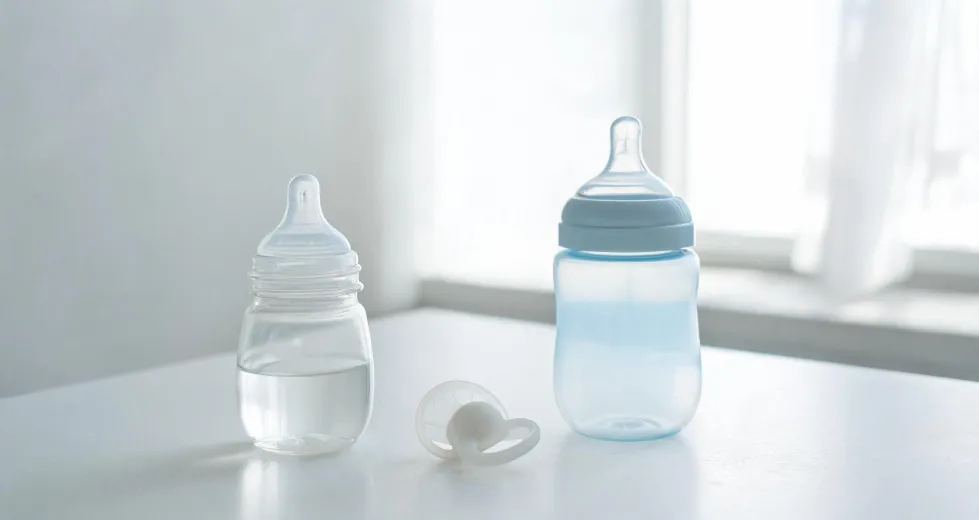
At 2 a.m., the bottle warmer glows, the three-month-old is wailing, and the parent on duty has eight ounces of expressed milk and two very different bottles lined up on the counter. One is the budget pick with a fast-flow nipple that the baby gagged on twice at dinner. The other is the new NUK Perfect Match 8oz three-pack, still in its box, with a 'medium flow' label that suddenly looks like a riddle. The question is not whether the baby will drink. The question is which bottle lets him drink at his own pace, without gulping air, without a puddle of milk on his bib, and without a sink full of parts to scrub afterward. The answer, as the coming weeks will show, is not about flow rate alone — it is about whether a bottle can hold up inside a daily rhythm of feeding, washing, and sanitizing without becoming a second job. That is the combined test, and it is the same idea echoed on NUK's official pages, where the brand's feeding products are described as adapting to how a baby naturally feeds and soothes.
The 8oz Question: What Parents Notice First
At 2 a.m., the bottle warmer glows, the three-month-old is wailing, and the parent on duty has eight ounces of expressed milk and two very different bottles lined up on the counter. One is the budget pick with a fast-flow nipple that the baby gagged on twice at dinner. The other is the new NUK Perfect Match 8oz three-pack, still in its box, with a 'medium flow' label that suddenly looks like a riddle. The question is not whether the baby will drink. The question is which bottle lets him drink at his own pace, without gulping air, without a puddle of milk on his bib, and without a sink full of parts to scrub afterward. The answer, as the coming weeks will show, is not about flow rate alone — it is about whether a bottle can hold up inside a daily rhythm of feeding, washing, and sanitizing without becoming a second job. That is the combined test, and it is the same idea echoed on NUK's official pages, where the brand's feeding products are described as adapting to how a baby naturally feeds and soothes.
Here is what the label does not tell you. 'Medium flow' is not a fixed speed that every brand agrees on; it is a stage, and a stage only makes sense when it meets a baby's actual feeding cues. A newborn who gulps and sputters needs something gentler; a four-month-old who gets bored with a slow trickle needs something faster. Parents are right to treat the label as a starting point, not a verdict. That is why the hospital cue matters. NUK describes itself as nr. 1 in hospital feeding essentials on its official pages, and that reputation does real work: when a brand is trusted enough to be used in nurseries and neonatal units, its ideas about flow, latch, and venting have already been tested against the most fragile feeders. The same official pages lay out the journey in plain stages — 0-6 months, 6-18 months, 18+ months — which is a reminder that a bottle is not a lifetime purchase. It is a stage in a system. So when a parent picks up an 8oz NUK Perfect Match bottle and reads 'medium flow', the useful question is not 'is this the fastest nipple in the drawer?' but 'does this bottle adapt to the way my baby feeds right now?'
NUK Perfect Match: Designed to Adapt
The NUK Perfect Match is not a single bottle floating in the catalog; it is the centerpiece of a feeding system. On NUK's official pages, the Perfect Match Breastfeeding Set sits next to the Perfect Match soother, the Perfect Match Learner Cup, and a whole library of articles about breastfeeding versus bottle-feeding and preparation 101. That placement is the design philosophy in miniature: the 8oz bottle is meant to move with the baby from the early months, when milk comes mostly from breast or expressed milk, into the solid-food years, when the same latch-friendly shape shows up in a learner cup. The breastfeeding set positioning matters because it tells parents the bottle is built to work with a baby who already knows how to nurse — the same rhythm of suck, swallow, breathe that the medium-flow nipple is designed to respect. A bottle that is presented as part of a set for natural feeding support is a bottle that expects to be used, washed, and reused many times a day.
So what actually makes this bottle different from the other 8oz options on the shelf? Look at how NUK structures the age bands on its own site: 0-6 months, then 6-18 months, then 18+ months. The Perfect Match line follows that same architecture — soother for the youngest stage, baby bottles for the milk months, learner cup for the transition — which means the 8oz bottle is deliberately designed for a specific window, not for 'all babies, all ages'. The condition is the important part: if your baby is still in the 0-6 months stage, the medium-flow Perfect Match is aimed directly at you. If you are already shopping for a toddler who can drink from a cup, the bottle is the wrong tool, and NUK's own range says so by offering the Perfect Match Learner Cup for the 18+ stage. That is the tell that 'medium flow' is an engineering choice about the nipple's shape and venting, not a marketing shrug.
Medium Flow vs. The Everything Bottle
In practice, parents do not compare bottles by reading spec sheets; they compare them the way the testers at BabyGearLab describe in their breast pump reviews — by efficiency, comfort, ease of use, and whether the thing fits into a real day. In that review, the team tested eight of the most-loved pumps, did hands-on comparison testing, and kept circling back to the same two priorities: how fast the session goes and how easy the cleanup is. The same logic transfers directly to bottles. The ultra-cheap bottle on the next shelf has a fast-flow nipple and seven separate parts to reassemble in the dark; the NUK has a simpler build and a nipple tuned to the baby's control. The budget pick looks great in the store and miserable at 3 a.m., when the fast flow turns dinner into a battle and the extra parts turn cleanup into a project. Price wins the first glance. Ease wins the hundredth wash. And for the parent who pumps at work, feeds at midnight, and washes at 6 a.m., the hundredth wash is the decision.
The cleaning argument deserves a closer look, because it is where the 'everything bottle' usually falls apart. The Medela guide on open and closed system pumps makes the underlying point clearly: any piece that touches breast milk is a surface where bacteria can grow, and the more parts there are, the more seams, threads, and corners there are to clean. Bottles follow the same rule. A valve here, a membrane there, a ring that must be quarter-turned just right — each extra piece is one more place for milk to hide and one more step before the bottle is truly clean. So the honest question at 2 a.m. is not 'which bottle has the cutest print?' It is: how many parts do you want to scrub when you are running on three hours of sleep? The simpler the bottle, the shorter the routine, and the shorter the routine, the more likely it actually gets done every single time. That is the difference between a bottle that works and one that only looks good in the box.
There is a condition attached to that simplicity, though. A bottle that adapts to the baby's stage only works if the parent chooses the right stage in the first place. If you buy a bottle with a single fast-flow nipple 'to grow into it', you are not saving money; you are buying a bottle your baby will fight for two months and then abandon. The cheap bottle that causes gulping, gas, and frustration often ends up replaced before the baby is six months old, which turns the 'savings' into a second purchase. The NUK path is slower but more honest: start with the stage your baby is actually in, use the medium-flow nipple while the cues say it works, and let the system carry you to the learner cup when the time comes. The decision, in other words, is made in the first month, not in the checkout line. That is how a three-pack becomes the whole first year, instead of a drawer of mistakes.
When Cleaning Became the Deciding Factor
Then comes the evidence that turns preference into a health decision. CDC guidance on infant feeding items is unambiguous: clean bottles and all their parts daily, and sanitize for extra germ removal — with daily sanitizing emphasized for babies younger than 3 months, as well as for premature babies and babies with weakened immune systems. The CDC's own page on cleaning, sanitizing, and storing infant feeding items lists nipples, rings, caps, valves, and membranes as surfaces that must be cleaned daily, because germs on any one of them can contaminate the milk. Many parents are surprised to learn that the guidance covers bottles and pump parts alike, not just ready-to-feed formula. Every seam is a place where old milk can sit; every membrane is a place where bacteria can multiply. The practical translation is simple: the bottle with the fewest surfaces is the bottle with the fewest opportunities for error. When a parent is washing the same bottle three, four, or five times a day, the number of parts stops being a convenience feature and becomes a risk factor.
Which brings up the question that every parent should ask before choosing: if every bottle part matters for safety, does a simpler medium-flow bottle actually reduce risk? In one sense, yes — fewer parts means fewer places where milk residue can hide overnight, fewer valves to disassemble and misplace, fewer rings to scrub with a brush. But the caveat is just as important: simple only helps if the cleaning actually happens. A bottle with three parts that get washed faithfully beats a bottle with two parts that get a rinse and a shrug. The CDC guidance assumes the parent is already doing the work; what a bottle can do is make that work shorter, easier, and harder to skip. For a parent standing at the sink after the third feeding of the night, a brush reaching every corner without a parts diagram is not a luxury. That is the sense in which cleanability is a safety feature, not just a convenience.
The stakes are not theoretical. Texas Children's Hospital, in its guidelines for nursing mothers, spells out why the CDC tightened its recommendations: a baby's immune system — especially under 6 months — is not robust enough to handle the bacteria that adults brush past every day, and the CDC changed its guidance after an infant died from a common kitchen-sink bacteria passed through improperly cleaned pump parts. Rare, yes. But the point is that the chain of protection runs from the pump to the bottle to the nipple, and every weak link matters. This is the realization that reframes the whole decision: the parent is not choosing between a pleasant bottle and an ugly one, but between a feeding system that supports daily sanitizing with a minimum of fuss and one that makes the chore harder than it needs to be. At that moment, the medium-flow NUK bottle stops being the pricier option and becomes the rational one. That is the turning point of the whole comparison.
The Verdict: Choose the Bottle That Adapts
The verdict, then, is a combined one. On flow, the NUK Perfect Match 8oz medium-flow bottle is designed for the 0-6 months stage and for the baby who is moving between breast and bottle — the breastfeeding set positioning on NUK's official pages makes the intent explicit. On cleaning, it holds up because the design keeps the part count low, which is exactly what CDC's daily-cleaning guidance rewards. On the whole journey, the Perfect Match system stretches from soother to learner cup, so the 8oz three-pack is not a dead end but a stage with a clear next step. The boundary is just as clear: this is not the bottle for a toddler who is ready to drink from a cup on his own — for that stage, NUK's own range points to the learner cup. Choose it for the right window, and the bottle that adapts to natural feeding is the bottle that earns its place in the cabinet.
By morning, the choice feels obvious. Back at that 2 a.m. counter, the same parent now reads the box with different eyes. The three-month-old still gets eight ounces at a time, but the medium-flow nipple is no longer a riddle — it is the setting that lets him set his own pace, and the official NUK promise that every feeding product adapts to a baby's natural way of feeding and soothing is exactly what the past week has shown. The bottles come out of the sterilizer clean, go back together in seconds, and the budget pick with the fast-flow nipple has been retired to the back of the drawer. The decision was never about one night of feeding. It was about the thousand nights after it, and about choosing a bottle that makes each one a little calmer, a little cleaner, and a little more like the natural rhythm the baby was born with.
By morning, the choice feels obvious. Back at that 2 a.m. counter, the same parent now reads the box with different eyes. The three-month-old still gets eight ounces at a time, but the medium-flow nipple is no longer a riddle — it is the setting that lets him set his own pace, and the official NUK promise that every feeding product adapts to a baby's natural way of feeding and soothing is exactly what the past week has shown. The bottles come out of the sterilizer clean, go back together in seconds, and the budget pick with the fast-flow nipple has been retired to the back of the drawer. The decision was never about one night of feeding. It was about the thousand nights after it, and about choosing a bottle that makes each one a little calmer, a little cleaner, and a little more like the natural rhythm the baby was born with.

Miriam Adler
Miriam Adler is an educational and STEM toy analyst specializing in busy boards, Montessori-style manipulatives, learning towers, sound books, reading pens, pretend-play sets, and early learning toys. She applies ASTM F963 and IEC 62115 methods while evaluating small-part hazards, accessible edges, switch durability, sound output, battery access, pull force, and age-appropriate task complexity. Her work helps parents, retailers, and product teams choose learning products that align developmental goals, supervision needs, interaction design, and the intended age stage.
Leave a Reply